


Navratri Day 3 Maa Chandraghanta 2026: Puja Vidhi, Mantra, Bhog, Color & Significance
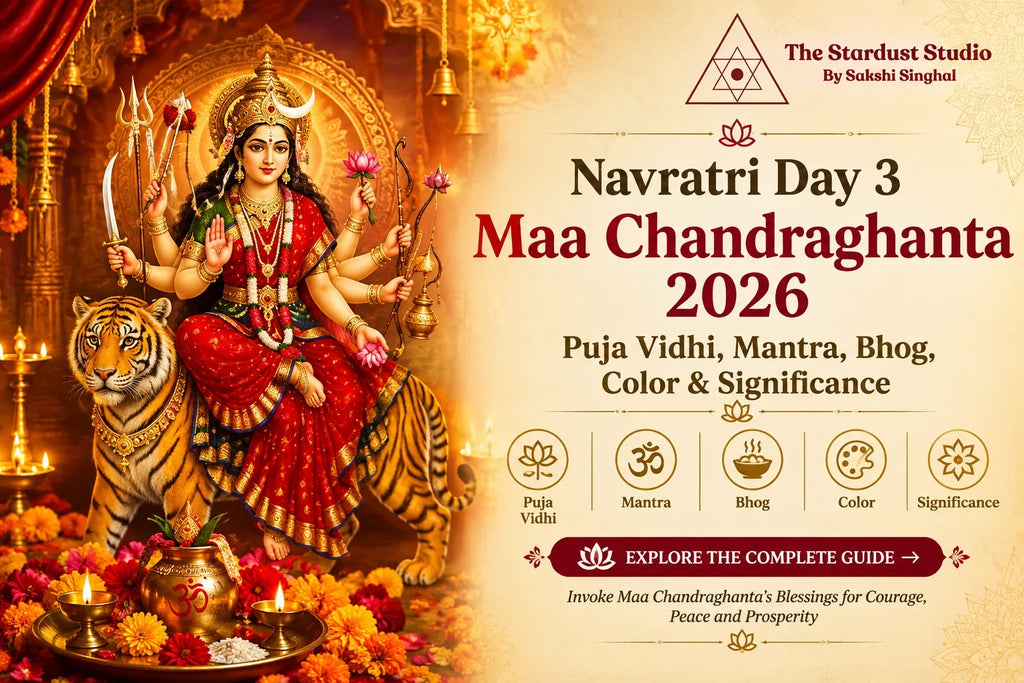
The third day of Shardiya Navratri is dedicated to Maa Chandraghanta, the third manifestation of Navdurga. Her powerful yet compassionate form traditionally represents courage, alertness, protection and the strength to confront fear.
In 2026, Maa Chandraghanta Puja will be observed on Tuesday, October 13. The day is also associated with Tritiya and Sindoor Tritiya in the Navratri calendar, while the traditional Navratri color for the day is Red.
As you prepare your Day 3 altar, permanent devotional pieces can complement the traditional flowers, diya, bhog and Kalash already established for Navratri. A Silver Lotus can add sacred floral symbolism, while Maha Lakshmi Desi Ghee may be incorporated into your ritual lamp if the product is intended for diya use.
If your home mandir already includes a Silver Navgrah Yantra or Lakshmi Shree Yantra, these can remain respectfully positioned in their established places without becoming the focus of Maa Chandraghanta Puja. Similarly, Silver Maha Lakshmi Charan and a Silver Fish may remain part of an auspicious silver collection while the central focus of Day 3 remains Maa Chandraghanta.
This complete guide covers Maa Chandraghanta 2026, Maa Chandraghanta Puja Vidhi, mantra, bhog, Navratri Day 3 color, traditional significance and simple ways to worship the Goddess at home.
Important: Navratri Puja traditions, offerings and fasting practices differ between families, regions and sampradayas. Follow your household tradition or priest's guidance wherever it differs from this general guide.
When Is Maa Chandraghanta Puja in 2026?
Maa Chandraghanta 2026 Puja Date: Tuesday, October 13, 2026
She is worshipped on the third day of Shardiya Navratri, following Maa Shailputri on Day 1 and Maa Brahmacharini on Day 2.
The 2026 Navratri calendar identifies October 13 as Navratri Day 3, Tritiya, Sindoor Tritiya and Chandraghanta Puja.
Devotees may continue worship of the Kalash established on Day 1 and perform a dedicated Maa Chandraghanta Puja with diya, flowers, mantra, bhog and Aarti.
Who Is Maa Chandraghanta?
Maa Chandraghanta is the third form of Goddess Durga worshipped during Navratri.
Her name is connected with the crescent moon on her forehead, traditionally described as resembling a Ghanta or bell.
Thus:
Chandra – Moon
Ghanta – Bell
Her form is traditionally depicted as powerful and prepared to confront negative forces, while simultaneously remaining compassionate toward devotees.
This combination makes Maa Chandraghanta a striking representation of strength balanced with grace.
Maa Chandraghanta Significance
The Maa Chandraghanta significance is traditionally connected with courage, protection and inner strength.
Courage : Her powerful form reminds devotees to face difficulties rather than constantly avoiding them.
Alertness : The bell symbolism can be interpreted as a reminder to remain spiritually aware and attentive.
Inner Strength : Maa Chandraghanta represents the strength required to remain composed when circumstances become challenging.
Protection : In devotional traditions, she is associated with protective Divine Mother symbolism.
Balance : Her form combines fierce strength with compassion, showing that power and gentleness do not have to be opposites.
Why Is Maa Chandraghanta Worshipped on Navratri Day 3?
The Navdurga sequence can be understood as a gradual spiritual progression.
Day 1 – Maa Shailputri: Foundation and stability
Day 2 – Maa Brahmacharini: Discipline and tapasya
Day 3 – Maa Chandraghanta: Courage and readiness
After establishing a firm foundation and developing discipline, the spiritual journey moves toward the courage required to face obstacles.
Maa Chandraghanta therefore represents a shift from inward discipline toward active strength.
Puja Essentials for Maa Chandraghanta Day 3
A clean Day 3 altar does not need to be overloaded with objects.
The primary focus should remain Maa Chandraghanta, the Navratri Kalash, diya, flowers and bhog.
If you already own permanent spiritual pieces, you can arrange them subtly around your mandir.
Silver Lotus
A Silver Lotus can provide a lasting sacred floral element in a Devi-inspired altar.
The lotus is widely used throughout Hindu iconography as a symbol associated with divinity, purity and spiritual growth.
Keep it on a clean, elevated surface while continuing to offer fresh flowers according to your household tradition.
Maha Lakshmi Desi Ghee
A diya forms part of many Navratri home-puja routines.
If your Maha Lakshmi Desi Ghee is specifically formulated for ritual use, it may be used in a suitable diya with a cotton wick according to its product instructions.
Never leave a diya unattended.
Silver Navgrah Yantra
If your mandir already contains a Silver Navgrah Yantra, there is no need to remove it for Maa Chandraghanta Puja.
Keep it respectfully in its established location while maintaining Maa Chandraghanta as the primary focus of Day 3 worship.
Lakshmi Shree Yantra
A Lakshmi Shree Yantra may similarly remain in an established home-mandir arrangement.
It is a separate sacred geometric object and should not be presented as a required component of Maa Chandraghanta Puja.
Silver Maha Lakshmi Charan
Silver Maha Lakshmi Charan carries Lakshmi-focused devotional symbolism and can remain part of a permanent silver puja collection.
Keep it clean and respectfully arranged rather than mixing every spiritual object into the central Day 3 offering.
Silver Fish
A Silver Fish can remain among your auspicious silver spiritual objects where it aligns with your household beliefs.
It is not a required item for Maa Chandraghanta Puja and should complement rather than replace the prescribed Navratri rituals.
Maa Chandraghanta Puja Vidhi at Home
The Maa Chandraghanta Puja Vidhi can be performed simply and devotionally.
Step 1: Clean Your Puja Space
Clean your home mandir and the area around the Navratri Kalash.
Bathe or wash according to your normal devotional routine and wear clean clothes.
Step 2: Light a Diya
Light a diya according to your family tradition.
If using Maha Lakshmi Desi Ghee for a ritual lamp, follow its stated usage instructions and use a suitable cotton wick.
Step 3: Worship the Navratri Kalash
Continue the daily worship of the Kalash established during Ghatasthapana.
Step 4: Offer Flowers
Offer fresh flowers to Maa Chandraghanta.
Keep your altar balanced and uncluttered.
Step 5: Offer Kumkum and Akshat
Offer Kumkum, Akshat and other customary puja materials according to your family practice.
Step 6: Offer Maa Chandraghanta Bhog
Prepare fresh Satvik bhog appropriate to your tradition.
Step 7: Chant Maa Chandraghanta Mantra
Sit quietly and chant the Goddess's mantra with attention and devotion.
Step 8: Perform Aarti
Complete the main worship with Durga Aarti or the Aarti followed in your household.
Maa Chandraghanta Mantra
A commonly recited Maa Chandraghanta mantra is:
ॐ देवी चन्द्रघण्टायै नमः॥
Om Devi Chandraghantayai Namah
You may chant it according to your regular practice.
Some devotees choose 11, 21 or 108 repetitions, but a particular count need not become a source of anxiety. Concentration and devotion remain central.
Maa Chandraghanta Prarthana
A traditional prayer associated with Maa Chandraghanta is:
पिण्डजप्रवरारूढा चण्डकोपास्त्रकैर्युता।
प्रसादं तनुते मह्यं चन्द्रघण्टेति विश्रुता॥
It may be recited during Day 3 worship according to your devotional practice.
Maa Chandraghanta Bhog: What Should You Offer?
Milk and milk-based preparations are commonly associated with Maa Chandraghanta Bhog in popular Navratri traditions.
Depending on your household practice, offerings may include:
- Milk
- Kheer
- Milk-based sweets
- Fresh fruits
- Other Satvik preparations
Offer fresh food and follow your family's dietary and ritual rules.
After the appropriate offering and prayer, the bhog can be distributed as prasad according to your tradition.
Navratri Day 3 Color 2026
The traditional weekday-based Navratri color for Tuesday, October 13, 2026 is Red.
Red is popularly associated with:
- Strength
- Passion
- Courage
- Energy
- Determination
These themes fit particularly well with Maa Chandraghanta's powerful form.
Devotees may choose red clothing, flowers or subtle red décor for the day.
Following the Navratri color tradition is optional and is not a requirement for the Puja to be meaningful.
Why Is the Bell Important in Maa Chandraghanta's Symbolism?
The "Ghanta" in Chandraghanta refers to the bell-shaped crescent associated with her forehead.
Bells also have an important place in Hindu worship.
The sound of a temple or puja bell traditionally marks the beginning of worship and helps create a distinct devotional atmosphere.
In symbolic interpretation, the bell can represent alertness and awakening.
Maa Chandraghanta's name therefore beautifully combines lunar imagery with the powerful symbolism of the Ghanta.
Simple Maa Chandraghanta Puja for Busy Devotees
If you cannot perform an elaborate ceremony, keep your Day 3 worship simple.
Light a diya, offer fresh flowers and suitable bhog, then chant:
Om Devi Chandraghantayai Namah
Spend a few moments in prayer and reflection.
You do not need an elaborate altar for sincere worship.
Maa Chandraghanta Vrat
Many devotees continue their Navratri fast on Day 3.
Depending on household tradition, vrat foods may include fruits, milk, curd, nuts, Makhana, Sabudana, potatoes, Samak rice, Kuttu, Singhara and Sendha Namak where permitted.
Some devotees eat once daily, while others follow fruit-based fasting.
Fasting should support spiritual discipline rather than cause physical harm. Anyone with medical or nutritional needs should adapt their vrat appropriately.
How to Arrange Your Day 3 Navratri Altar
A simple arrangement can include:
- Maa Durga or Chandraghanta image
- Navratri Kalash
- Diya
- Fresh flowers
- Bhog
- Silver Lotus
If your permanent mandir already contains your Silver Navgrah Yantra, Lakshmi Shree Yantra, Silver Maha Lakshmi Charan or Silver Fish, keep these pieces in their regular locations rather than moving everything toward the central Goddess image.
This helps maintain a clean visual hierarchy and keeps the Day 3 worship focused.
Can You Use Maha Lakshmi Desi Ghee During Navratri?
If your Maha Lakshmi Desi Ghee is intended specifically for ritual use, it can be incorporated into a diya according to its usage instructions.
Use only a suitable lamp and cotton wick, keep the diya on a stable heat-resistant surface and never leave an open flame unattended.
If the product is designated for ritual use rather than food consumption, do not offer it as edible bhog.
Spiritual Lesson of Maa Chandraghanta
Maa Chandraghanta teaches that spiritual growth is not only about remaining peaceful when life is easy.
It also requires the courage to remain centred when difficulties appear.
Day 1 establishes stability.
Day 2 develops discipline.
Day 3 introduces courage.
This progression makes Maa Chandraghanta an important stage in the Navdurga journey: inner discipline develops into fearless action.
Why Explore The Stardust Studio for Navratri Puja Essentials?
At The Stardust Studio, our spiritual collection brings together devotional symbolism with thoughtfully designed products for home mandirs and festive worship.
For Navratri, you can explore pieces such as:
Silver Lotus – a lasting sacred floral symbol for a Devi-inspired altar.
Silver Navgrah Yantra – a permanent sacred geometric piece for Navgraha-focused worship.
Silver Maha Lakshmi Charan – a Lakshmi-inspired devotional representation for an auspicious home-mandir collection.
Maha Lakshmi Desi Ghee – for sacred ritual use according to the product's specific instructions.
Lakshmi Shree Yantra – a sacred geometric symbol traditionally connected with Divine Feminine and prosperity-focused worship.
Silver Fish – an auspicious silver piece that can complement a permanent spiritual collection where it aligns with household tradition.
These pieces can support a meaningful devotional environment while the core Navratri worship remains centred on Maa Durga and the Navdurga form of the day.
Final Thoughts
Maa Chandraghanta 2026 will be worshipped on Tuesday, October 13, the third day of Shardiya Navratri, and the traditional color for the day is Red.
Her powerful form represents an important stage in the Navdurga journey. Maa Shailputri establishes the foundation, Maa Brahmacharini teaches discipline, and Maa Chandraghanta inspires devotees to transform that inner strength into courage.
Keep your Day 3 worship sincere and uncluttered: light a diya, offer flowers and appropriate bhog, chant the Maa Chandraghanta mantra, and reflect on the strength required to face challenges with composure.
For your Navratri home mandir, spiritual pieces such as a Silver Lotus, Silver Navgrah Yantra, Silver Maha Lakshmi Charan, Maha Lakshmi Desi Ghee, Lakshmi Shree Yantra and Silver Fish from The Stardust Studio can complement your permanent devotional collection while Maa Chandraghanta remains the central focus of Day 3 worship.
Frequently Asked Questions
1. When is Maa Chandraghanta Puja in 2026?
2. What is the Maa Chandraghanta mantra?
3. What is Maa Chandraghanta Bhog?
4. What is the Navratri Day 3 color in 2026?
5. What is Maa Chandraghanta significance?


