


Navratri Day 2 Maa Brahmacharini 2026: Puja Vidhi, Mantra, Bhog, Color & Significance
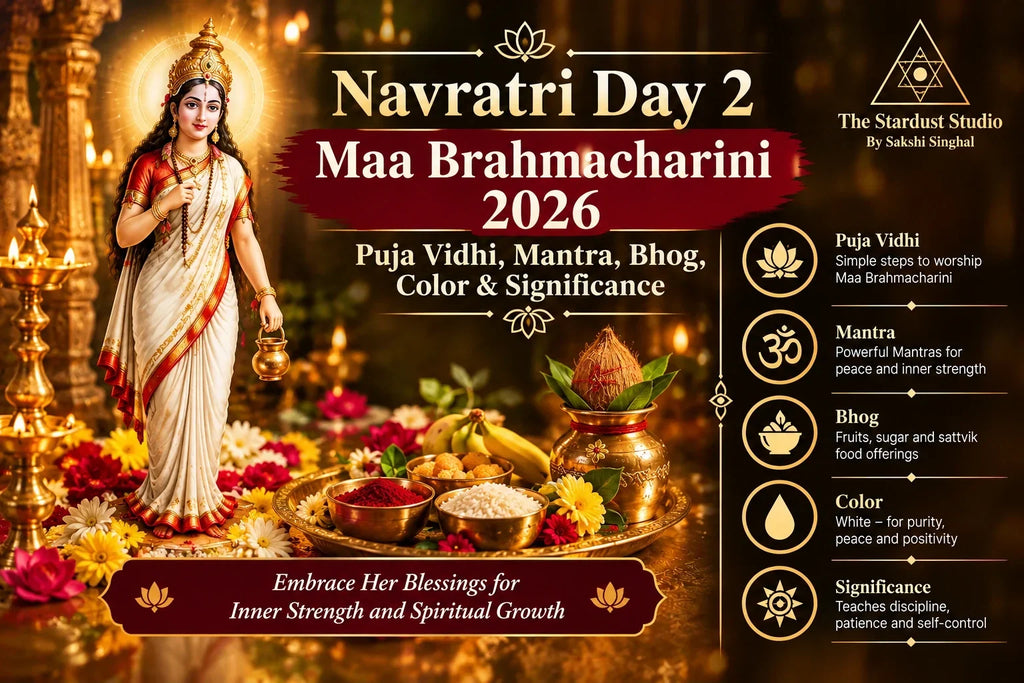
The second day of Shardiya Navratri is dedicated to Maa Brahmacharini, the second form of Navdurga. Her serene form represents tapasya, devotion, patience, self-discipline and unwavering determination on the spiritual path.
In 2026, Maa Brahmacharini Puja will be observed on Monday, October 12, following Ghatasthapana and Maa Shailputri worship on the first day of Navratri.
Maa Brahmacharini is traditionally depicted walking barefoot, carrying a Japa Mala in her right hand and Kamandalu in her left. Her simple appearance carries an important message: spiritual strength does not always need to appear fierce. It can also emerge through patience, restraint, prayer and consistent practice.
This makes a Rudraksha Japa Mala especially relevant to the symbolism of Day 2. Devotees who use Japa as part of their established practice can keep their mala ready for mantra chanting. Traditional puja essentials such as Silver Laung, Silver Supari and Silver Paan may also be kept in a permanent silver puja collection where their use aligns with household traditions.
These silver representations should complement the altar rather than automatically replace natural Laung, Supari or Paan when a particular Puja Vidhi specifically calls for the real ingredients.
This complete guide covers Maa Brahmacharini 2026, her Puja Vidhi, mantra, bhog, Navratri Day 2 color, significance, fasting practices and simple ways to worship her at home.
Important: Navratri rituals, offerings and fasting customs vary between families and regions. Follow your household tradition, Guru or priest's guidance wherever it differs from this general guide.
When Is Maa Brahmacharini Puja in 2026?
Maa Brahmacharini Puja 2026 Date: Monday, October 12, 2026
She is worshipped on the second day of Shardiya Navratri, following Maa Shailputri.
The day is traditionally connected with Dwitiya Tithi and focuses on the second manifestation of Goddess Durga.
Devotees may perform morning puja, offer bhog, chant Maa Brahmacharini mantras and continue their Navratri vrat according to family tradition.
Who Is Maa Brahmacharini?
The name Brahmacharini reflects a form of the Goddess associated with spiritual discipline, tapasya and devoted pursuit of the Divine.
In traditional narratives, this form is connected with Goddess Parvati's intense penance to attain Lord Shiva.
Her iconography is strikingly simple.
She is commonly depicted:
- Walking barefoot
- Wearing simple white clothing
- Holding a Japa Mala
- Carrying a Kamandalu
Unlike some of Durga's more martial forms, Maa Brahmacharini does not require elaborate weapons to express strength.
Her strength lies in discipline and determination.
Maa Brahmacharini Significance
Maa Brahmacharini carries a particularly meaningful message for modern life.
- Devotion : Her form represents unwavering commitment to one's spiritual path.
- Discipline : She reminds devotees that meaningful progress usually requires consistency rather than occasional effort.
- Patience : Tapasya is not instant. Maa Brahmacharini symbolizes the patience required to continue even when results take time.
- Inner Strength : Her calm appearance represents strength that comes from within rather than from outward force.
- Simplicity : Maa Brahmacharini's minimal form reminds devotees that spiritual practice does not depend on elaborate possessions.
Why Is Maa Brahmacharini Worshipped on Navratri Day 2?
The Navdurga sequence can be viewed as a gradual spiritual journey.
Day 1 begins with Maa Shailputri, whose mountain symbolism represents grounding and establishing a firm foundation.
Day 2 moves into discipline and tapasya through Maa Brahmacharini.
Once the foundation has been established, the devotee learns consistency, patience and commitment.
This progression gives Day 2 a powerful spiritual lesson:
Beginning is important, but continuing with discipline is what creates transformation.
Also Read : Navratri Day 1 Maa Shailputri 2026: Puja Vidhi, Mantra, Bhog, Color & Significance
Maa Brahmacharini and the Japa Mala
One of the most recognizable elements in Maa Brahmacharini's traditional form is the Japa Mala in her right hand.
A Japa Mala is traditionally used to count mantra repetitions during devotional practice.
This makes Day 2 particularly meaningful for devotees who want to begin or strengthen a regular mantra routine.
A Rudraksha Japa Mala can be used for mantra chanting where this aligns with your personal spiritual tradition.
If your mala contains 108 beads and is designed specifically for Japa, it can help you maintain a consistent repetition count.
Rudraksha Japa Mala for Navratri Day 2
A Rudraksha Japa Mala can complement Maa Brahmacharini worship because the Goddess herself is depicted holding a mala.
Before Japa, sit in a clean and quiet place.
Hold your mala according to the technique followed in your spiritual tradition and chant slowly rather than rushing through repetitions.
The mala is a tool for maintaining focus; the real emphasis remains on mantra, devotion and concentration.
Silver Puja Essentials for Maa Brahmacharini Day
If you maintain a permanent collection of silver puja objects, Day 2 can also be an opportunity to organize your altar.
Silver Supari
A Silver Supari can remain among your reusable puja essentials where symbolic silver representations are accepted.
If your specific ritual calls for natural Supari, however, continue using the actual betel nut.
Silver Laung
A Silver Laung is a permanent representation of clove that can be kept in your puja collection.
It should not be burned, consumed or automatically substituted for natural Laung when actual cloves are prescribed.
Silver Paan
A Silver Paan can provide a lasting representation of the traditional Paan leaf used in different Hindu ceremonies.
As with other silver miniatures, distinguish between symbolic representation and the fresh leaf when a Puja Vidhi specifically requires natural Paan.
Maa Brahmacharini Puja Vidhi at Home
The Maa Brahmacharini Puja Vidhi can be kept simple.
Step 1: Clean the Puja Space
Clean your mandir and the area surrounding the Ghatasthapana Kalash established on Day 1.
Bathe or wash according to your normal devotional routine and wear clean clothes.
Step 2: Light a Diya
Light a diya and incense according to your family tradition.
If your household maintains an Akhand Jyoti during Navratri, follow appropriate fire-safety precautions.
Step 3: Worship the Kalash
Continue worship of the Kalash established on the first day according to your Navratri practice.
Step 4: Offer Flowers
Offer fresh flowers to Maa Brahmacharini.
Keep the altar simple, clean and devotional.
Step 5: Offer Kumkum and Akshat
Offer the traditional puja materials used in your household.
Step 6: Offer Bhog
Prepare a suitable Satvik Maa Brahmacharini Bhog according to your family tradition.
Step 7: Chant Maa Brahmacharini Mantra
Sit quietly and perform mantra Japa.
A Rudraksha Japa Mala can be used if appropriate to your practice.
Step 8: Perform Aarti
Conclude the main puja with Durga Aarti or the Aarti traditionally followed in your home.
Also Read : Navratri 2026: Dates, Ghatasthapana Muhurat, 9 Days Puja Vidhi & Significance
Maa Brahmacharini Mantra
A simple and commonly recited Maa Brahmacharini mantra is:
ॐ देवी ब्रह्मचारिण्यै नमः॥
Om Devi Brahmacharinyai Namah
You may chant the mantra according to your personal practice.
Some devotees chant 11, 21 or 108 repetitions, but devotion and concentration are more important than treating a particular number as compulsory.
Maa Brahmacharini Prarthana
A traditional prayer associated with Maa Brahmacharini is:
दधाना कर पद्माभ्यामक्षमाला कमण्डलु।
देवी प्रसीदतु मयि ब्रह्मचारिण्यनुत्तमा॥
The prayer reflects her traditional iconography with the Japa Mala and Kamandalu.
It can be recited during Day 2 worship according to your devotional practice.
Maa Brahmacharini Bhog: What Should You Offer?
Sugar or Mishri is commonly associated with Maa Brahmacharini's Day 2 bhog in popular Navratri traditions.
Depending on your household practice, you may offer:
- Sugar
- Mishri
- Fruits
- Simple Satvik sweets
- Other permitted Navratri bhog
The offering should be fresh and prepared respectfully.
Regional traditions vary, so don't feel obligated to replace your established family bhog simply because another offering is popular online.
Navratri Day 2 Color 2026
For the weekday-based Navratri color tradition, Day 2 on Monday, October 12, 2026 is associated with White.
White traditionally symbolizes qualities such as:
- Purity
- Peace
- Simplicity
- Calmness
- Clarity
This also complements Maa Brahmacharini's serene and disciplined form.
Devotees may choose white clothing or incorporate white elements into their festive décor.
Wearing the day's color is a popular Navratri custom rather than a compulsory requirement for worship.
How to Perform Mantra Japa on Maa Brahmacharini Day
Because the Japa Mala is such an important part of Maa Brahmacharini's imagery, Day 2 can be an excellent time to establish a regular mantra practice.
Choose a quiet location and sit comfortably.
Take a few calm breaths before beginning.
Using your Rudraksha Japa Mala, repeat:
Om Devi Brahmacharinyai Namah
slowly and attentively.
Avoid turning Japa into a race to complete 108 repetitions. The practice is intended to support focus and devotion.
Maa Brahmacharini Vrat
Many devotees continue the Navratri fast on Day 2.
Depending on tradition, permitted foods may include:
- Fruits
- Milk
- Curd
- Makhana
- Nuts
- Sabudana
- Samak rice
- Potatoes
- Kuttu
- Singhara
- Sendha Namak
Some devotees eat once daily, while others follow fruit-based or other forms of fasting.
The purpose of vrat is spiritual discipline rather than harming the body. Anyone with health conditions or special nutritional requirements should adapt appropriately.
Can You Use Silver Laung During Navratri Puja?
A Silver Laung can be kept as part of your permanent silver puja collection where this aligns with household tradition.
However, remember the distinction:
Natural Laung is an actual clove and may be required as an ingredient in certain rituals.
Silver Laung is a permanent metal representation.
If a ritual calls for actual cloves, use natural Laung rather than substituting silver automatically.
Can Silver Supari Be Used in Navratri Puja?
The same principle applies to Silver Supari.
If your household uses a reusable silver representation as part of the puja setup, it may be incorporated accordingly.
If your Kalash or another ritual specifically requires a natural Supari, continue using the real betel nut.
Follow the Puja Vidhi rather than assuming that all natural offerings have interchangeable silver alternatives.
What Is the Role of Silver Paan?
A Silver Paan is a lasting representation of the Paan leaf.
Fresh betel leaves have roles in different Hindu ceremonies and offerings.
A silver version can remain among your permanent devotional objects, but it should not automatically replace fresh Paan where the natural leaf is specifically required.
This distinction helps preserve both traditional ritual practice and the meaning of silver symbolic items.
Simple Maa Brahmacharini Puja for Busy Devotees
If you don't have time for an elaborate ritual, your Day 2 worship can still be meaningful.
Light a diya, offer fresh flowers and suitable bhog, then chant:
Om Devi Brahmacharinyai Namah
using your Japa Mala if desired.
Spend a few quiet minutes reflecting on discipline, patience and consistency.
That simple routine closely reflects the deeper symbolism of Maa Brahmacharini.
What Can We Learn from Maa Brahmacharini?
Maa Brahmacharini's symbolism is particularly relevant in a world where people often expect quick results.
Her story represents the opposite approach.
She teaches the value of:
- Patience over urgency
- Consistency over occasional intensity
- Simplicity over unnecessary excess
- Devotion over appearance
- Discipline over distraction
These principles can be applied beyond spiritual practice—to study, work, relationships and personal development.
Maa Brahmacharini Puja Setup
A clean Day 2 altar can include:
- Maa Durga or Brahmacharini image
- Ghatasthapana Kalash
- Diya
- Fresh flowers
- Bhog
- Rudraksha Japa Mala
- Silver Supari
- Silver Laung
- Silver Paan
Keep Maa Brahmacharini and the Kalash as the central focus.
The additional products should support the devotional arrangement rather than make the altar visually crowded.
Why Choose Puja Essentials from The Stardust Studio?
At The Stardust Studio, we believe spiritual products should complement traditional worship through thoughtful craftsmanship and meaningful symbolism.
For Maa Brahmacharini and Navratri Day 2, you can explore:
Rudraksha Japa Mala – especially meaningful for Day 2 because Maa Brahmacharini is traditionally depicted holding a Japa Mala.
Silver Laung – a reusable symbolic silver representation suitable for a permanent puja collection.
Silver Supari – a lasting silver puja essential where its symbolic use aligns with your household tradition.
Silver Paan – a permanent representation of the traditional Paan leaf for devotional collections and auspicious gifting.
Always distinguish between permanent silver representations and natural ritual ingredients when following a specific Puja Vidhi.
Final Thoughts
Maa Brahmacharini 2026 will be worshipped on Monday, October 12, the second day of Shardiya Navratri.
Her simple form—with a Japa Mala in one hand and Kamandalu in the other—offers one of Navratri's most important lessons: genuine strength can come from patience, discipline, simplicity and unwavering devotion.
For your Day 2 practice, you can use a Rudraksha Japa Mala from The Stardust Studio for mantra chanting where appropriate to your tradition. Silver Laung, Silver Supari and Silver Paan can also complement a permanent silver puja collection while natural ingredients should continue to be used whenever the specific Puja Vidhi requires them.
Keep your altar simple, offer Maa Brahmacharini fresh bhog and flowers, chant her mantra with concentration, and let Day 2 of Navratri become a reminder that lasting spiritual growth is built through consistency.
Frequently Asked Questions
1. When is Maa Brahmacharini Puja in 2026?
2. What is the Maa Brahmacharini mantra?
3. What is Maa Brahmacharini Bhog?
4. What is the Navratri Day 2 color in 2026?
5. Why does Maa Brahmacharini hold a Japa Mala?


