


Navratri Day 8 Maa Mahagauri 2026: Puja Vidhi, Mantra, Bhog
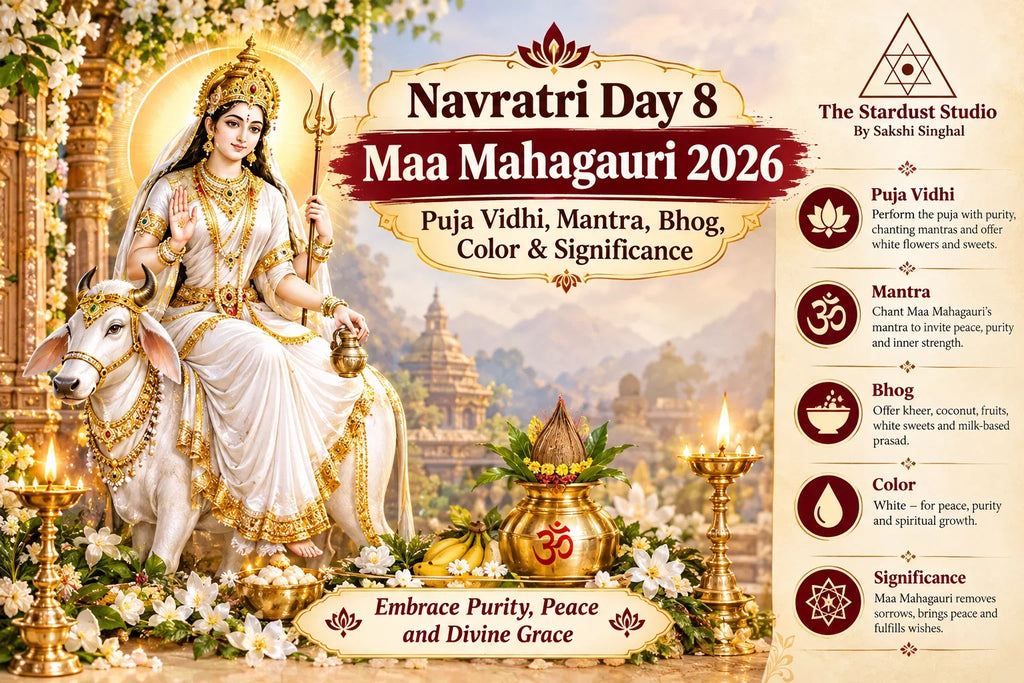
The eighth day of Shardiya Navratri is dedicated to Maa Mahagauri, the eighth manifestation of Navdurga. Her serene form represents purity, peace, compassion, spiritual clarity and transformation.
In 2026, Maa Mahagauri Navratri Day 8 falls on Sunday, October 18. The traditional weekday-based Navratri color for the day is Peacock Green, a rich shade popularly associated with individuality, freshness and grace.
Day 8 is also closely connected with Durga Ashtami or Maha Ashtami traditions. Depending on Tithi and household custom, devotees may perform special Devi Puja, Havan and Kanya Pujan around Ashtami/Navami.
For your Day 8 mandir, devotional products such as a Silver Trishul and Silver Lotus can complement Devi symbolism, while a Silver Swastik can remain as an auspicious symbol in the home temple. A Silver Diya can be incorporated into daily Aarti where it is designed for lamp use, while a Silver Tulsi Plant may remain respectfully in its established devotional space.
These items can enhance a permanent home-mandir collection, but none should be presented as compulsory for Maa Mahagauri Puja Vidhi.
This guide covers Maa Mahagauri Puja Vidhi, Maa Mahagauri Mantra, Maa Mahagauri Bhog, Maa Mahagauri Puja Color 2026, significance, vrat, Kanya Puja and simple Day 8 worship at home.
Important: Navratri Puja, Kanya Pujan, Havan and fasting traditions differ between families, regions and sampradayas. Tithi-specific rituals should follow your local Panchang and established household tradition.
When Is Maa Mahagauri Navratri Day 8 in 2026?
Maa Mahagauri Puja 2026 Date: Sunday, October 18, 2026
Maa Mahagauri is worshipped as the eighth form of Navdurga.
The Navdurga journey reaches Day 8 after:
Day 1: Maa Shailputri
Day 2: Maa Brahmacharini
Day 3: Maa Chandraghanta
Day 4: Maa Kushmanda
Day 5: Maa Skandamata
Day 6: Maa Katyayani
Day 7: Maa Kalaratri
Day 8: Maa Mahagauri
Devotees continue their Navratri Kalash worship and offer dedicated prayer to Maa Mahagauri.
Who Is Maa Mahagauri?
Maa Mahagauri is traditionally depicted in a serene, radiant form.
Her name combines:
Maha – great
Gauri – fair, radiant or luminous
She is traditionally shown riding a bull and carrying a Trishul and Damru, while her other hands are depicted in sacred mudras.
Her luminous appearance creates a striking contrast with the fierce form of Maa Kalaratri worshipped on Day 7.
This progression itself carries an important symbolic message:
After confronting darkness comes clarity.
Maa Mahagauri Significance
Maa Mahagauri is traditionally associated with several spiritual themes.
- Purity : Her radiant appearance represents purity and spiritual refinement.
- Peace : Unlike the fierce imagery of Day 7, Mahagauri's form is calm and serene.
- Transformation : The progression from Kalaratri to Mahagauri can symbolize moving through difficulty toward greater clarity.
- Compassion : Her gentle form represents the nurturing and compassionate dimension of Divine Shakti.
- New Beginnings : Purification can also represent releasing what no longer serves us and beginning again with greater awareness.
Why Is Maa Mahagauri Worshipped on Navratri Day 8?
The Navdurga sequence has now reached one of its final stages.
Maa Shailputri established stability.
Maa Brahmacharini developed discipline.
Maa Chandraghanta introduced courage.
Maa Kushmanda represented creative energy.
Maa Skandamata added compassion.
Maa Katyayani represented decisive action.
Maa Kalaratri confronted darkness.
Now Maa Mahagauri represents clarity and purification after transformation.
Day 8 therefore carries a simple but meaningful lesson:
Difficult transformation can eventually create clarity.
Puja Essentials for Maa Mahagauri Day 8
The Goddess, Navratri Kalash, diya, flowers and bhog should remain the central elements.
Permanent silver spiritual objects can complement the altar.
Silver Trishul
A Silver Trishul is particularly relevant because Maa Mahagauri is traditionally depicted holding a Trishul.
It can be kept respectfully near the Devi altar as a permanent devotional symbol.
Silver Lotus
A Silver Lotus can complement a Devi-focused altar through the lotus's broader sacred associations with purity, divinity and spiritual growth.
Continue offering fresh flowers according to your Puja Vidhi.
Silver Swastik
A Silver Swastik can remain in your mandir as a traditional Hindu symbol of auspiciousness and well-being.
It does not require a separate Day 8 ritual.
Silver Diya
A Silver Diya can be used for your Navratri lamp or Aarti if the individual product is designed for burning oil or ghee.
Place it on a stable, heat-resistant surface and keep the flame supervised.
Silver Tulsi Plant
A Silver Tulsi Plant can remain in your home mandir during Navratri.
Tulsi has particularly strong devotional associations with Vishnu and Krishna traditions, so it should be viewed as a permanent sacred symbol rather than a required Maa Mahagauri offering.
Maa Mahagauri Puja Vidhi
A simple Maa Mahagauri Puja Vidhi can be performed at home.
Step 1: Clean the Puja Space
Clean your home mandir and the area around the Navratri Kalash.
Bathe or wash according to your regular devotional practice and wear clean clothes.
Step 2: Light the Diya
Light your diya according to household tradition.
A Silver Diya can be used if it is designed for ritual-lamp use.
Keep the flame away from curtains, dry flowers, loose clothing and other flammable objects.
Step 3: Worship the Navratri Kalash
Continue the daily worship of the Kalash established during Ghatasthapana.
Step 4: Offer Flowers
Offer fresh flowers to Maa Mahagauri.
Keep your Silver Lotus as a permanent symbolic object if desired while continuing to use actual flowers for offerings.
Step 5: Offer Kumkum and Akshat
Offer Kumkum, Akshat and other traditional puja materials according to your household custom.
Step 6: Offer Maa Mahagauri Bhog
Prepare fresh Satvik bhog according to your Day 8 or family tradition.
Step 7: Chant Maa Mahagauri Mantra
Sit quietly and chant the Goddess's mantra with concentration.
Step 8: Perform Aarti
Complete the worship with Durga Aarti or the Aarti traditionally followed in your home.
Maa Mahagauri Mantra
A commonly recited Maa Mahagauri Mantra is:
ॐ देवी महागौर्यै नमः॥
Om Devi Mahagauryai Namah
You may chant according to your personal devotional practice.
Some devotees choose 11, 21 or 108 repetitions, but sincere concentration is more important than becoming anxious about completing a particular number.
Maa Mahagauri Prarthana
A traditional prayer associated with Maa Mahagauri is:
श्वेते वृषे समारूढा श्वेताम्बरधरा शुचिः।
महागौरी शुभं दद्यान्महादेवप्रमोददा॥
Devotees may recite it during Day 8 worship according to their spiritual tradition.
Maa Mahagauri Bhog
Coconut is popularly associated with Maa Mahagauri Bhog during Navratri.
Depending on your household tradition, you may offer:
- Coconut
- Coconut-based sweets
- Fresh fruits
- Satvik sweets
- Other permitted homemade bhog
Use a fresh and appropriate offering.
After Puja, the bhog can be distributed as prasad according to your household practice.
Why Is Coconut Offered to Maa Mahagauri?
Coconut is widely mentioned in contemporary Navratri traditions as an offering for Maa Mahagauri.
It also has a longstanding place in Hindu ritual practice more broadly.
However, regional and family customs differ.
If your family traditionally offers a different Satvik bhog on Ashtami, continue following that tradition rather than changing it solely because another offering appears on an online list.
Maa Mahagauri Puja Color
The traditional weekday-based Maa Mahagauri Puja Color is Peacock Green for Sunday, October 18.
Peacock Green is popularly associated with:
- Grace
- Individuality
- Freshness
- Beauty
- Renewal
Devotees may choose Peacock Green clothing or incorporate the shade subtly into festive styling.
The Navratri color tradition is optional and is not a compulsory condition for Maa Mahagauri worship.
Maa Mahagauri and the Silver Trishul
The Trishul has particular relevance to Maa Mahagauri because it forms part of her traditional iconography.
A Silver Trishul can therefore complement a Day 8 Devi altar particularly well.
Keep it:
- Clean
- Elevated
- Securely positioned
- Away from the diya flame
The Trishul should remain a devotional symbol rather than becoming the main focus over the Goddess herself.
Maa Mahagauri and Purity
Purity in spiritual symbolism should not be reduced simply to physical cleanliness.
It can also represent:
- Clear intentions
- Honest communication
- Ethical behaviour
- Letting go of resentment
- Simplifying unnecessary complications
- Beginning again after mistakes
This gives Maa Mahagauri's symbolism practical relevance beyond the Puja itself.
Durga Ashtami and Maa Mahagauri
Maa Mahagauri is traditionally associated with the eighth Navdurga day, which is why her worship is closely connected in popular practice with Durga Ashtami or Maha Ashtami.
However, lunar Tithis do not always align perfectly with simple midnight-to-midnight calendar days.
For Tithi-specific practices such as Ashtami Puja, Havan or Kanya Pujan, follow your local Panchang and family tradition rather than relying only on the “Day 8” label.
Kanya Pujan on Navratri Day 8
Many families perform Kanya Pujan or Kumari Puja around Ashtami or Navami.
Practices vary, but the ritual generally involves respectfully welcoming young girls, offering food and giving suitable gifts or Dakshina according to tradition.
If your family performs Kanya Pujan, prioritize:
- Respect
- Clean food
- Comfort
- Consent and appropriate boundaries
- Simple, thoughtful gifting
The children should be treated as guests with dignity rather than merely as components of a ritual checklist.
What Food Is Commonly Served During Kanya Pujan?
A popular North Indian Kanya Pujan meal includes:
- Puri
- Kala Chana
- Halwa
However, regional traditions vary considerably.
Follow your family's customary meal and ensure food is prepared hygienically.
Maa Mahagauri Vrat
Many devotees continue their Navratri vrat on Day 8.
Depending on household tradition, vrat foods may include fruits, milk, curd, Makhana, nuts, Sabudana, potatoes, Samak rice, Kuttu, Singhara and Sendha Namak where permitted.
Some devotees conclude their fasting around Ashtami, while others continue through Navami.
Follow the vrat cycle traditionally observed in your household.
People with health conditions or special nutritional needs should adapt fasting appropriately.
Can You Use Silver Diya During Maa Mahagauri Puja?
Yes, provided your Silver Diya is designed for actual lamp use.
You can use an appropriate cotton wick with the ghee or oil followed in your family tradition.
Because silver conducts heat, handle the diya carefully after burning and allow it to cool before touching or cleaning it.
Can Silver Lotus Be Used During Maa Mahagauri Puja?
A Silver Lotus can complement the altar as a permanent sacred floral symbol.
However, it does not automatically replace fresh flowers where your Puja Vidhi calls for floral offerings.
Use the silver piece as a lasting devotional object and fresh flowers as the actual offering according to your tradition.
Can Silver Tulsi Plant Be Kept During Devi Puja?
Yes. A Silver Tulsi Plant can remain in the home mandir during Navratri.
There is no need to remove existing Vishnu- or Krishna-associated devotional symbols when worshipping Maa Durga.
Simply maintain Maa Mahagauri as the central Day 8 focus.
Common Maa Mahagauri Puja Mistakes
Overcomplicating the Ritual
Simple and attentive worship is sufficient for many home devotees.
Treating the Day's Color as Mandatory
Peacock Green is a popular Navratri tradition, not a condition for receiving divine blessings.
Overcrowding the Mandir
Allow the Goddess and Kalash to remain visually central.
Ignoring Tithi for Ashtami Rituals
Check your local Panchang when performing Tithi-specific Kanya Puja or Havan.
Treating Spiritual Products as Guaranteed Remedies
Silver devotional objects can carry meaningful symbolism but should not be presented as guaranteed sources of prosperity, protection or other outcomes.
What Can Maa Mahagauri Teach Us?
Day 8 follows the fierce transformation represented by Maa Kalaratri.
The sequence itself offers a beautiful message:
After darkness can come clarity.
After struggle can come wisdom.
After letting go can come renewal.
Maa Mahagauri can therefore inspire devotees to simplify what has become unnecessarily complicated and move forward with clearer intentions.
Why Explore The Stardust Studio for Navratri Puja Essentials?
At The Stardust Studio, our spiritual collection combines traditional symbolism with thoughtfully crafted devotional products for home mandirs and festive worship.
For Maa Mahagauri Day 8 and your permanent puja collection, you can explore:
Silver Trishul – especially meaningful because the Trishul appears in Maa Mahagauri's traditional iconography.
Silver Lotus – a lasting sacred floral symbol associated broadly with purity, divinity and spiritual growth.
Silver Swastik – an auspicious Hindu symbol suitable for a permanent home-mandir arrangement.
Silver Diya – a traditional silver lamp for Puja and Aarti where the product is designed for actual flame use.
Silver Tulsi Plant – a permanent silver representation inspired by sacred Tulsi for a devotional collection.
These products can complement your sacred space while Maa Mahagauri and the Navratri Kalash remain at the heart of Day 8 worship.
Final Thoughts
Maa Mahagauri Navratri Day 8 will be observed on Sunday, October 18, 2026, with Peacock Green as the traditional color of the day.
Her radiant and peaceful form marks an important stage in the Navdurga journey. After Maa Kalaratri represents confronting darkness on Day 7, Maa Mahagauri symbolizes purification, renewal and greater clarity.
Frequently Asked Questions
1. When is Maa Mahagauri Navratri Day 8 in 2026?
2. What is the Maa Mahagauri Mantra?
3. What is Maa Mahagauri Bhog?
4. What is Maa Mahagauri Puja Color 2026?
5. What is the significance of Maa Mahagauri?


