


Sarva Pitru Amavasya 2026: Date, Tithi & Shraddha Vidhi
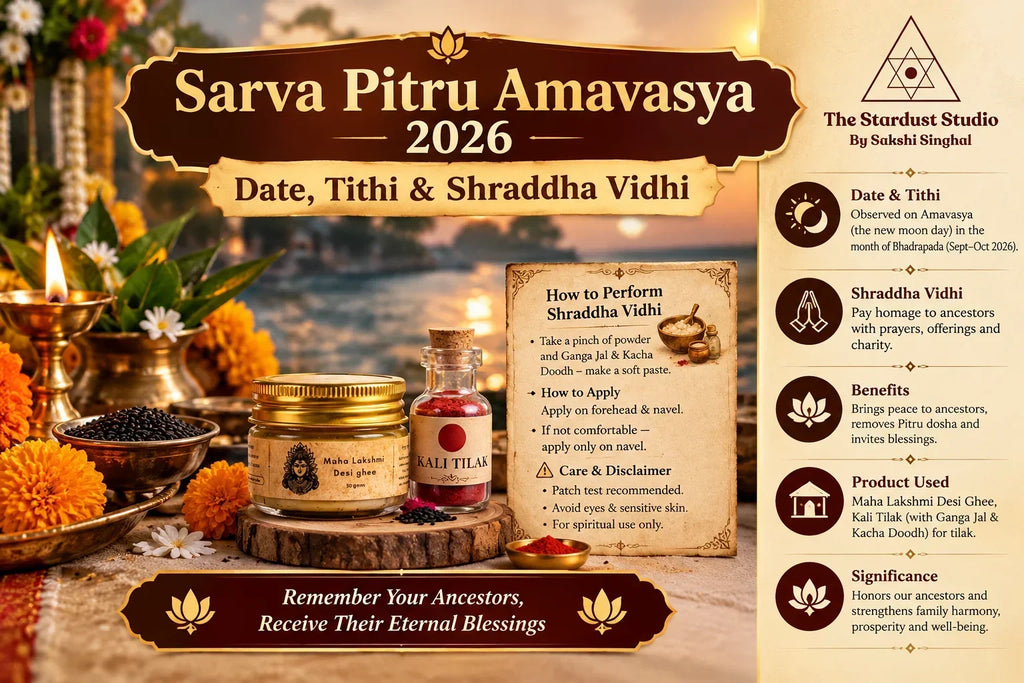
Sarva Pitru Amavasya is the concluding and one of the most significant days of Pitru Paksha, the annual period dedicated to remembering and honouring one's ancestors.
Also known as Sarvapitri Amavasya, Mahalaya Amavasya, Pitru Amavasya and Sarva Pitru Moksha Amavasya, the day holds particular importance for families who do not know an ancestor's exact death Tithi or were unable to perform Shraddha on the appropriate Pitru Paksha date.
In 2026, the Sarva Pitru Amavasya date is Saturday, October 10. For New Delhi, the Sarva Pitru Amavasya Tithi begins at 9:35 PM on October 9 and ends at 9:19 PM on October 10.
The day is traditionally observed through Shraddha, Tarpan, Pinda Daan, food offerings, charity and remembrance of ancestors according to one's family tradition.
Some households also prefer to keep their home and puja space calm and spiritually prepared during Pitru Paksha. Products such as Navgraha Aura Cleanser, Mahakali Oil and Mahakali Tilak may be used separately according to their intended spiritual-use instructions, while Maha Lakshmi Desi Ghee may be used in a ritual diya where appropriate. These are optional contemporary spiritual practices and do not replace traditional Shraddha, Tarpan or Pinda Daan.
Important: Shraddha procedures differ considerably between families, regions and sampradayas. Formal ancestral rites should ideally follow your family's established practice or the guidance of a knowledgeable priest.
Sarva Pitru Amavasya Date 2026
Sarva Pitru Amavasya 2026 Date: Saturday, October 10, 2026
It falls on Ashwina Krishna Amavasya and marks the final Shraddha Tithi of Pitru Paksha.
The 2026 Pitru Paksha sequence concludes as follows:
October 8: Trayodashi Shraddha
October 9: Chaturdashi Shraddha
October 10: Sarva Pitru Amavasya
Sarva Pitru Amavasya is particularly significant for collective ancestral remembrance.
Sarva Pitru Amavasya Tithi 2026
For New Delhi:
Amavasya Tithi Begins: 9:35 PM on October 9, 2026
Amavasya Tithi Ends: 9:19 PM on October 10, 2026
The Shraddha itself is not traditionally scheduled simply according to the moment Amavasya begins.
Pitru Paksha Shraddha gives particular importance to the Aparahna, or afternoon period.
Sarva Pitru Amavasya 2026 Shraddha Timings
For New Delhi on October 10, 2026:
Kutup Muhurat: 11:45 AM – 12:31 PM
Rohina Muhurat: 12:31 PM – 1:18 PM
Aparahna Kaal: 1:18 PM – 3:37 PM
These timings are location-specific.
If you live outside Delhi, check the Panchang for your city before performing time-sensitive Shraddha rituals.
What Is Sarva Pitru Amavasya?
Sarva Pitru Amavasya is the final Amavasya of Pitru Paksha.
The name itself helps explain its purpose:
Sarva – all
Pitru – ancestors
Amavasya – new-moon Tithi
It is therefore widely understood as an important day for collectively remembering one's ancestors.
Traditionally, it is especially relevant when:
- The ancestor's exact death Tithi is unknown
- The death Tithi has been forgotten
- Shraddha could not be performed on the appropriate Pitru Paksha Tithi
- A family follows collective ancestral Shraddha on Amavasya
The exact eligibility and procedure can differ according to family tradition.
Why Is Sarva Pitru Amavasya Important?
Most Pitru Paksha Shraddhas are traditionally performed according to the lunar Tithi on which an ancestor passed away.
Sarva Pitru Amavasya provides an important concluding occasion for broader ancestral remembrance.
This makes the day particularly significant for families who may not know the exact Tithi of earlier generations.
It is also an opportunity to remember not only parents and grandparents but one's wider ancestral lineage.
Sarva Pitru Amavasya Significance
The deeper Sarva Pitru Amavasya significance can be understood through four central ideas.
1. Remembering Our Ancestors
The day creates a dedicated opportunity to remember the generations that preceded us.
2. Expressing Gratitude
Our lives are influenced by family histories, sacrifices, knowledge and traditions passed through generations.
Shraddha literally carries the idea of performing an act with Shraddha—faith and sincerity.
3. Preserving Family Traditions
Ancestral rituals help transmit cultural and family practices from one generation to another.
4. Charity and Giving
Acts of feeding and donation form an important part of many Shraddha traditions.
Sarva Pitru Amavasya can therefore encourage both remembrance and generosity.
Sarva Pitru Amavasya Shraddha Vidhi
The complete Sarva Pitru Amavasya Shraddha Vidhi can be detailed and varies according to lineage and tradition.
For formal Shraddha, priestly guidance is recommended.
A general structure may include the following.
Step 1: Prepare Yourself and the Ritual Space
Bathe and wear clean, simple clothing according to your tradition.
Clean the area where the ancestral rites will be performed.
Keep the environment calm and respectful.
Step 2: Take Sankalpa
Begin with the Sankalpa for the ancestors for whom the Shraddha is being performed.
Traditional Sankalpa can involve names, Gotra and other lineage information.
Follow your priest or family tradition for the appropriate wording.
Step 3: Perform Tarpan
Water is offered in remembrance of ancestors according to prescribed ritual practice.
Black sesame or Til is commonly used in Pitru Tarpan traditions.
Step 4: Perform Pinda Daan Where Prescribed
Pindas are ritual offerings prepared according to the Shraddha tradition being followed.
The ingredients and procedure can vary.
Step 5: Offer Food
Food offerings are prepared according to family custom.
Different households have different rules regarding ingredients and preparation.
Step 6: Feeding and Charity
Many Shraddha traditions include feeding Brahmins and giving Dakshina.
Some households also follow customs involving feeding cows, crows, dogs or other living beings.
Follow your family's established practice.
Step 7: Complete the Shraddha and Tarpan
Conclude the ritual according to the prescribed Vidhi and offer a final prayer for your ancestors.
What Is Tarpan?
Tarpan is a ritual water offering performed for ancestors and, in other contexts, for deities or Rishis.
During Pitru Paksha, Pitru Tarpan is performed specifically in remembrance of departed ancestors.
Depending on tradition, it can involve:
- Water
- Black sesame seeds
- Kusha grass
- Specific hand positions
- Mantras
- Directional rules
Because these details vary, first-time practitioners should ideally learn the correct procedure from a knowledgeable priest or experienced family member.
Why Is Black Sesame Used in Tarpan?
Black sesame, or Kala Til, has an established place in many Pitru-related rituals.
It is traditionally included in water offerings and other ancestral rites according to prescribed practice.
Its ritual significance comes from scriptural and customary Shraddha traditions rather than from any scientifically established physical effect.
Follow the quantities and procedure used within your family's Vidhi.
What Is Pinda Daan?
Pinda Daan involves preparing and offering ritual Pindas for departed ancestors.
The exact ingredients and method vary according to tradition.
Pinda Daan is especially associated with important ancestral pilgrimage locations such as Gaya, although families also perform prescribed ancestral rites in other sacred locations and at home.
If performing Pinda Daan for the first time, formal guidance is preferable to relying solely on generic online instructions.
Who Should Be Remembered on Sarva Pitru Amavasya?
Sarva Pitru Amavasya can be used for collective ancestral remembrance according to one's tradition.
This may include:
- Parents
- Grandparents
- Great-grandparents
- Earlier ancestors
- Ancestors whose death Tithi is unknown
- Other departed family members according to customary rules
Formal Shraddha conventions can differ regarding who performs the ritual and for whom, so follow your lineage tradition where applicable.
Can Shraddha Be Performed at Home?
Many families perform Shraddha and Tarpan at home.
However, formal procedures can be detailed.
If your family has traditionally used priestly guidance, continue that practice.
Simple remembrance, prayer and charity can also be meaningful for people who are unable to perform a complete formal Shraddha, although these should not automatically be presented as identical replacements for prescribed rites.
What Food Is Prepared on Sarva Pitru Amavasya?
Shraddha food traditions vary significantly across India.
Families often prepare simple Satvik food according to their lineage and regional custom.
The best approach is to follow the food traditionally prepared in your family rather than using one universal internet menu.
If a priest is conducting the Shraddha, ask them about the required food and offerings in advance.
Charity on Sarva Pitru Amavasya
Charity is an important element in many ancestral traditions.
Depending on household practice and personal capacity, people may give:
- Food
- Clothing
- Dakshina
- Useful household essentials
- Support to people in need
The purpose should remain genuine giving rather than treating charity as a transactional guarantee of a particular result.
Preparing the Home for Sarva Pitru Amavasya
The home can be kept simple, clean and peaceful.
Begin by physically cleaning the area where prayer or Shraddha will take place.
If you follow additional spiritual-cleansing practices, these can be kept separate from the formal ancestral rites.
For example, a Navgraha Aura Cleanser may be used according to its individual bathing or spiritual-use instructions as part of personal preparation.
Likewise, Mahakali Oil may be used separately according to its stated ritual directions where such practices form part of your household spiritual routine.
These are complementary contemporary practices—not requirements of Sarva Pitru Amavasya.
Using Maha Lakshmi Desi Ghee for a Diya
A diya may form part of household prayer according to family tradition.
If your Maha Lakshmi Desi Ghee is specifically intended for ritual-lamp use, it may be used with a suitable cotton wick according to its product instructions.
Keep the diya:
- On a stable surface
- Away from curtains and fabrics
- Away from children and pets
- Supervised while burning
Do not confuse lighting a diya with the formal Shraddha or Tarpan procedure.
Mahakali Oil During Pitru Paksha
Some people prefer spiritual home-cleansing routines during Pitru Paksha.
If Mahakali Oil forms part of your established practice, use it according to the product's intended instructions and appropriate fire-safety precautions.
It should be viewed as a separate spiritual practice rather than an ancestral offering.
Do not add it to Tarpan water, Pindas or Shraddha food unless a legitimate ritual tradition specifically prescribes such use.
Mahakali Tilak During Sarva Pitru Amavasya
Mahakali Tilak may be used as part of personal devotional practice according to its product directions.
However, it is not a standard substitute for the materials required in formal Pitru Shraddha.
Keep its use separate from ancestral offerings unless your established tradition specifically directs otherwise.
Navgraha Aura Cleanser During Pitru Paksha
A Navgraha Aura Cleanser can be incorporated into a personal bathing or spiritual-cleansing routine where desired.
Use it according to its product instructions.
The purpose is to complement your personal preparation and spiritual routine—not to replace bathing, Sankalpa, Tarpan, Pinda Daan or other Shraddha procedures.
What Should Be Avoided During Sarva Pitru Amavasya?
Customs vary, but Pitru Paksha is generally approached as a period of simplicity and ancestral remembrance.
Many families traditionally avoid major celebratory Shubh Karya during this period.
More importantly:
- Avoid treating ancestral rituals casually.
- Avoid mixing random online remedies into formal Shraddha.
- Avoid making fear-based claims about ancestors.
- Avoid wasting food prepared for ritual purposes.
- Avoid performing unfamiliar complex rituals without guidance.
Sarva Pitru Amavasya should be approached with respect rather than fear.
Is Sarva Pitru Amavasya the Last Day of Pitru Paksha?
Yes. Sarva Pitru Amavasya on October 10, 2026 marks the concluding Shraddha day of Pitru Paksha.
The following day, October 11, begins Shardiya Navratri observances in the 2026 calendar.
This creates a distinct transition from the ancestral remembrance period of Pitru Paksha into the Devi-focused worship of Navratri.
Why Explore The Stardust Studio for Spiritual Cleansing & Puja Essentials?
At The Stardust Studio, our spiritual collection includes products intended to complement different devotional and personal spiritual practices.
During Pitru Paksha and Sarva Pitru Amavasya, you can explore:
Maha Lakshmi Desi Ghee – for sacred ritual-lamp use according to the product's instructions.
Mahakali Oil – a spiritual-use product intended for cleansing-focused practices according to its specified ritual directions.
Mahakali Tilak – for personal devotional use according to the product instructions.
Navgraha Aura Cleanser – for personal spiritual-cleansing routines according to its intended method of use.
These products should complement your broader spiritual routine while traditional Shraddha, Tarpan and Pinda Daan remain distinct ancestral practices.
Final Thoughts
Sarva Pitru Amavasya 2026 falls on Saturday, October 10, marking the culmination of Pitru Paksha and one of the most important days for collective ancestral remembrance.
The Sarva Pitru Amavasya Tithi begins at approximately 9:36 PM on October 9 and ends around 9:20 PM on October 10. Because Shraddha is traditionally performed during appropriate afternoon periods rather than simply when Amavasya begins, devotees should check their local Panchang for the correct Kutup, Rohina and Aparahna timings.
Through Shraddha, Tarpan, charity and prayer, families create space to acknowledge those who came before them and preserve a connection with their lineage.
Personal spiritual products such as Maha Lakshmi Desi Ghee, Mahakali Oil, Mahakali Tilak and Navgraha Aura Cleanser from The Stardust Studio can complement your broader devotional or cleansing routine where appropriate, but traditional ancestral rites should remain rooted in your family and sampradaya practices.
Frequently Asked Questions
1. What is the Sarva Pitru Amavasya date in 2026?
2. What is the Sarva Pitru Amavasya Tithi in 2026?
3. What is the best time for Shraddha on Sarva Pitru Amavasya 2026?
4. What is Sarva Pitru Amavasya Shraddha Vidhi?
5. What is the significance of Sarva Pitru Amavasya?


