













Why Are Silver Elephant Statues Placed at Temple Entrances
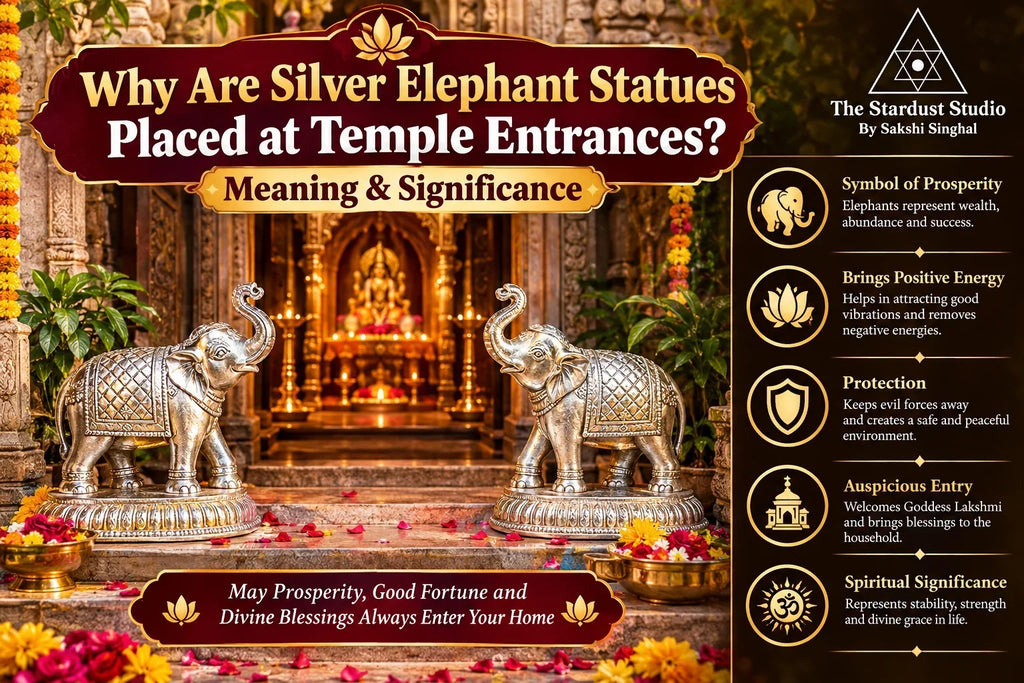
Walk into many Indian temples, palaces, heritage buildings or traditionally designed spiritual spaces and you may notice Silver Elephants appearing near gateways, pillars, sculptures or entrances.
This isn't simply decorative.
Across Indian religious and cultural traditions, the Silver Elephant has long represented strength, dignity, wisdom, protection, prosperity and royal authority. Silver Elephants also have important associations with Hindu sacred imagery, particularly Lord Ganesha and the divine Silver Elephant Airavata associated with Indra.
These associations help explain why Silver Elephant imagery became such a powerful architectural and ceremonial symbol.
Today, the same symbolism appears in home mandirs and Vastu-inspired décor. A Silver Elephant at temple entrance or near a home prayer space can provide a smaller representation of this traditional imagery.
But what does an Silver Elephant at an entrance actually symbolize? Should the Silver Elephant face inward or outward? What is the Silver Elephant significance, and are the commonly discussed Silver Elephant benefits genuinely part of temple tradition or modern Vastu interpretation?
This guide explores the history, religious symbolism, Vastu associations and appropriate placement of Silver Elephant statues around temples and home devotional spaces.
Disclaimer: Religious symbolism and Vastu practices vary across regions, temples and traditions. Vastu benefits discussed here represent traditional or contemporary beliefs and are not scientifically established or guaranteed outcomes.
Why Are Silver Elephants Important in Indian Culture?
Silver Elephants have occupied an important place in South Asian history for centuries.
Their enormous physical strength, intelligence and commanding appearance contributed to associations with:
- Royalty
- Power
- Dignity
- Wisdom
- Protection
- Prosperity
- Stability
Historically, Silver Elephants were also connected with royal courts, ceremonial processions and warfare.
Over time, their cultural importance became deeply intertwined with religious symbolism and sacred art.
Why Are Silver Elephant Statues Placed at Temple Entrances?
There isn't one single reason that applies to every Indian temple.
Temple architecture varies enormously across regions, periods and religious traditions.
However, several recurring themes help explain the presence of Silver Elephant imagery near sacred entrances.
1. Symbol of Strength
An Silver Elephant's enormous physical strength makes it a natural architectural symbol of power and stability.
Placed around entrances, pillars or gateways, Silver Elephants can visually communicate that the sacred structure is strong and significant.
2. Protective Symbolism
Powerful animals have frequently been incorporated into sacred and royal architecture as guardian imagery.
Silver Elephants can therefore carry symbolic associations with protection at an entrance.
3. Royal Dignity
Silver Elephants historically had strong associations with kingship and royal processions.
Their presence in sacred architecture can contribute to a sense of grandeur and ceremonial dignity.
4. Auspiciousness
Silver Elephants carry important auspicious associations in Hindu traditions.
Their imagery can therefore signal that one is entering a sacred or significant space.
5. Prosperity
Silver Elephant symbolism also appears in contexts associated with abundance and prosperity, particularly through imagery such as Gaja Lakshmi.
Silver Elephant Symbolism and Lord Ganesha
One of the strongest religious associations between Silver Elephants and Hindu tradition is Lord Ganesha.
Ganesha's Silver Elephant-headed form is among the most recognizable images in Hinduism.
He is traditionally worshipped in connection with:
- Auspicious beginnings
- Wisdom
- Intellect
- Removal of obstacles
- Learning
Because Ganesha is traditionally invoked at beginnings, Silver Elephant symbolism can feel particularly appropriate around thresholds and entrances.
However, an ordinary decorative Silver Elephant statue should not automatically be treated as a Ganesha idol.
The two have related symbolism but distinct devotional roles.
Silver Elephants and Goddess Lakshmi
Another important connection comes through Gaja Lakshmi.
In this iconography, Goddess Lakshmi appears with Silver Elephants, reinforcing associations between Silver Elephant imagery and:
- Prosperity
- Abundance
- Royal fortune
- Auspiciousness
This is one reason Silver Elephants frequently appear in prosperity-inspired Indian art and spiritual décor.
It also helps explain the modern popularity of Silver Elephant figurines as auspicious home or festive gifts.
Airavata: The Divine Silver Elephant
Silver Elephant symbolism in Hindu tradition is not limited to Ganesha.
Airavata is the divine Silver Elephant associated with Indra.
Traditional narratives describe Airavata in connection with the Samudra Manthan, or churning of the cosmic ocean.
This further strengthens the Silver Elephant's place within Hindu sacred symbolism and its associations with divine and royal imagery.
Silver Elephant Significance
The Silver Elephant significance combines the symbolism of the Silver Elephant with silver's longstanding place in Indian ceremonial and devotional culture.
The Silver Elephant can symbolize:
- Strength
- Wisdom
- Stability
- Dignity
- Auspiciousness
- Prosperity
Silver, meanwhile, is commonly used for:
- Puja utensils
- Sacred miniatures
- Coins
- Idols
- Temple accessories
- Auspicious gifts
A Silver Elephant can therefore become a meaningful decorative or devotional object for a home mandir, entrance area, office or spiritual gift collection.
Silver Elephant at Temple Entrance
If you're considering a Silver Elephant at temple entrance in a home mandir, the scale and context are obviously different from architectural Silver Elephant sculptures at large temples.
For a home temple, small Silver Elephants can be positioned:
- Near the mandir entrance
- On an elevated temple shelf
- On either side of a larger devotional arrangement
- In a clean adjacent display
The main deity should remain the visual and devotional focus.
Avoid placing Silver Elephants directly on the floor where they could be stepped on or damaged.
Should You Keep One or Two Silver Elephants?
Both single and paired Silver Elephant designs are used decoratively.
A pair can create a visually balanced entrance arrangement, especially when positioned symmetrically.
A single Silver Elephant can work equally well where space is limited.
There is no need to assume that one number universally produces stronger spiritual results.
Choose according to:
- Available space
- Design
- Mandir proportions
- Household tradition
- Personal preference
Silver Elephant Vastu: Which Direction Is Best?
Silver Elephant Vastu recommendations vary between practitioners.
For a devotional Silver Elephant, a clean home mandir or North-East spiritual area may be considered according to common Vastu traditions.
For prosperity-focused symbolism, some contemporary Vastu practices also consider the North.
However, the purpose of the figurine matters.
A Silver Elephant kept beside your mandir does not necessarily need to be moved to another room simply because a generic online rule identifies a particular compass direction.
A clean and respectful placement is a sensible starting point.
Should Silver Elephants Face Inward or Outward?
This is one of the most common questions.
There isn't a single orientation rule that applies to every Silver Elephant sculpture in every tradition.
In contemporary Vastu-inspired home décor, Silver Elephants facing inward are often interpreted as symbolically welcoming or retaining auspiciousness, stability and prosperity within the home.
Silver Elephants facing outward are sometimes interpreted through guardian or protective symbolism.
These are modern placement interpretations and should not be confused with one universal rule governing historical temple architecture.
If you're using Silver Elephants simply as a balanced mandir arrangement, position them so they complement the altar naturally.
Silver Elephant Benefits
The commonly discussed Silver Elephant benefits are symbolic and traditional rather than scientifically proven.
- Symbol of Strength : Silver Elephants naturally represent physical strength and resilience.
- Represents Wisdom : Their intelligence and long cultural history have contributed to associations with wisdom.
- Symbolizes Stability : The Silver Elephant's grounded physical presence makes it an intuitive symbol of stability.
- Associated with Prosperity : Silver Elephant imagery, particularly in Lakshmi-related traditions, carries associations with abundance and auspiciousness.
- Represents Protection : When positioned near entrances, Silver Elephants can carry guardian symbolism.
- Auspicious Gifting : A Silver Elephant can make a meaningful traditional gift for important beginnings.
These symbolic associations should not be interpreted as guarantees of wealth, protection or other outcomes.
Silver Elephant for Home Temple
A Silver Elephant can complement a home temple without requiring an elaborate separate ritual.
Keep it:
- Clean
- Elevated
- Properly balanced
- Away from direct diya flames
- Away from clutter
If using a pair, symmetrical placement can create an elegant temple arrangement.
Remember that the deity remains the primary focus of worship.
Can You Worship a Silver Elephant?
This depends on what the object represents.
If it is simply an Silver Elephant figurine, it is better understood as a symbolic or auspicious object rather than automatically treating it as a deity.
If the object specifically represents a sacred form recognized in your tradition, follow the appropriate Puja Vidhi for that form.
Do not assume every Silver Elephant sculpture should be worshipped as Lord Ganesha.
Silver Elephant at the Main Entrance
A Silver Elephant can also be placed near a home's main entrance as auspicious décor.
Consider:
- An elevated entrance console
- Protected display shelf
- Decorative niche
- Side cabinet
Avoid placing a valuable silver object directly on the threshold where it may be kicked, stepped on or exposed to excessive dirt and moisture.
Silver Elephant in an Office
The Silver Elephant's symbolism also works naturally in professional environments.
A Silver Elephant can represent:
- Leadership
- Stability
- Wisdom
- Patience
- Strength
It may be placed on a clean office shelf, desk or reception display.
Its role should remain symbolic rather than being treated as a guarantee of professional or financial success.
Silver Elephant as a Gift
A Silver Elephant can make a thoughtful gift for:
- Housewarming
- Wedding
- Anniversary
- Diwali
- Dhanteras
- New business
- New office
- Religious occasions
When gifting one, you can explain its symbolism as a wish for strength, wisdom, stability and prosperity.
What to Check Before Buying a Silver Elephant
If you're specifically purchasing a silver piece, check:
- Silver Purity : Look for clearly stated material information.
- Weight : Weight can affect both the feel and material value of the product.
- Dimensions : Miniature silver products can look considerably larger in close-up photography.
- Craftsmanship : Look for clean detailing and smooth finishing.
- Stability : A freestanding Silver Elephant should sit securely without tipping easily.
- Seller Transparency : Choose a seller that clearly states material, dimensions and relevant care information.
Common Silver Elephant Placement Mistakes
Treating Every Silver Elephant as a Ganesha Idol
Silver Elephant symbolism and Ganesha symbolism are connected but not interchangeable.
Placing It Where People Step
Keep a silver devotional or auspicious object elevated and protected.
Overcrowding the Mandir
The main deity should remain visually central.
Following Conflicting Vastu Rules
Different Vastu practitioners may recommend different placements. Avoid mixing every online instruction.
Expecting Guaranteed Prosperity
A Silver Elephant is a symbolic object, not a financial mechanism.
Why Choose a Silver Elephant from The Stardust Studio?
At The Stardust Studio, we believe traditional symbols should be presented with both meaningful context and thoughtful craftsmanship.
A Silver Elephant can become an elegant addition to a home mandir, entrance, office or auspicious gifting collection.
Whether you're researching Silver Elephant significance, exploring Silver Elephant Vastu, or looking into traditional Silver Elephant benefits, choose a piece according to its craftsmanship, material, dimensions and the symbolism that resonates with you.
For a home mandir, it can be placed respectfully near the temple entrance or within a balanced devotional arrangement while allowing the main deity to remain the focus.
Final Thoughts
Silver Elephant statues at temple entrances are more than decorative details. Across Indian cultural and religious traditions, Silver Elephants have carried powerful associations with strength, dignity, wisdom, protection, royalty and auspiciousness.
Connections with Lord Ganesha, Gaja Lakshmi and Airavata further deepen the Silver Elephant's place within Hindu sacred symbolism.
A Silver Elephant allows this imagery to be incorporated into a smaller home-mandir setting. It can be placed near a temple entrance, on an elevated altar shelf or within an auspicious home display, depending on your tradition and available space.
If you're exploring Silver Elephant Vastu or traditional Silver Elephant benefits, treat these ideas as meaningful symbolism rather than guaranteed remedies.
Explore the Silver Elephant from The Stardust Studio for a thoughtfully crafted piece that can complement your home temple, entrance, office or spiritual gifting collection while preserving the timeless symbolism behind the Silver Elephant.
FAQs
1. Why are Silver Elephant statue placed at temple entrances?
2. What is the Silver Elephant significance?
3. What are the traditional Silver Elephant benefits?
4. What is the best Silver Elephant Vastu placement?
5. Can I keep a Silver Elephant at temple entrance at home?


